Late May, Spring warmth, a tinny Mozart jingle as the plane touches down in Vienna. I’m here to write a report on the Independent Space Index: A weekend-long event mapping and coordinating the goings on of 80-something art spaces who in a variety of ways are defined as ‘independent’. The annual festival took place for the first time in October 2018 with 27 participating project spaces, and this year featured more than 60 exhibitions and over 70 events. I did not make it to all of them.
LUNCH
I meet the festival team for lunch in the sunny courtyard of Amerlingbeisl and, while tackling a messy asparagus salad, bond with one of the other flown-in writers over a shared ambivalence towards art criticism: what it is and isn’t, what we want it to be, and what’s stopping us from making it that now . After espressos we’re joined by a small entourage of other press people to begin a tour of the nearest spaces. The sun whips in and out of cloud, the mood is leisurely, jaunty.
ENTRE
First up is Entre with Beyond the High. The Chemsex Experience: Crisis, Resilience and Community. Featuring artists from the Viennese cultural association Club Havera, the exhibition takes on the challenge of representing both the liberatory and the destructive aspects of chemsex: a site for queer connection and pleasure without shame, but also as one troubled by the risks of eroded boundaries, alienation, and addiction. Artworks here include a looming projection of one artist’s video self-portraits during chemsex gatherings, a grubby mattress embroidered with descriptions of late-night, dwindling illusions, and, in the street-facing window, a miniature army of red 3D-printed figures, their goblin-like contortions illustrating a series of movements associated with a GHB overdose.
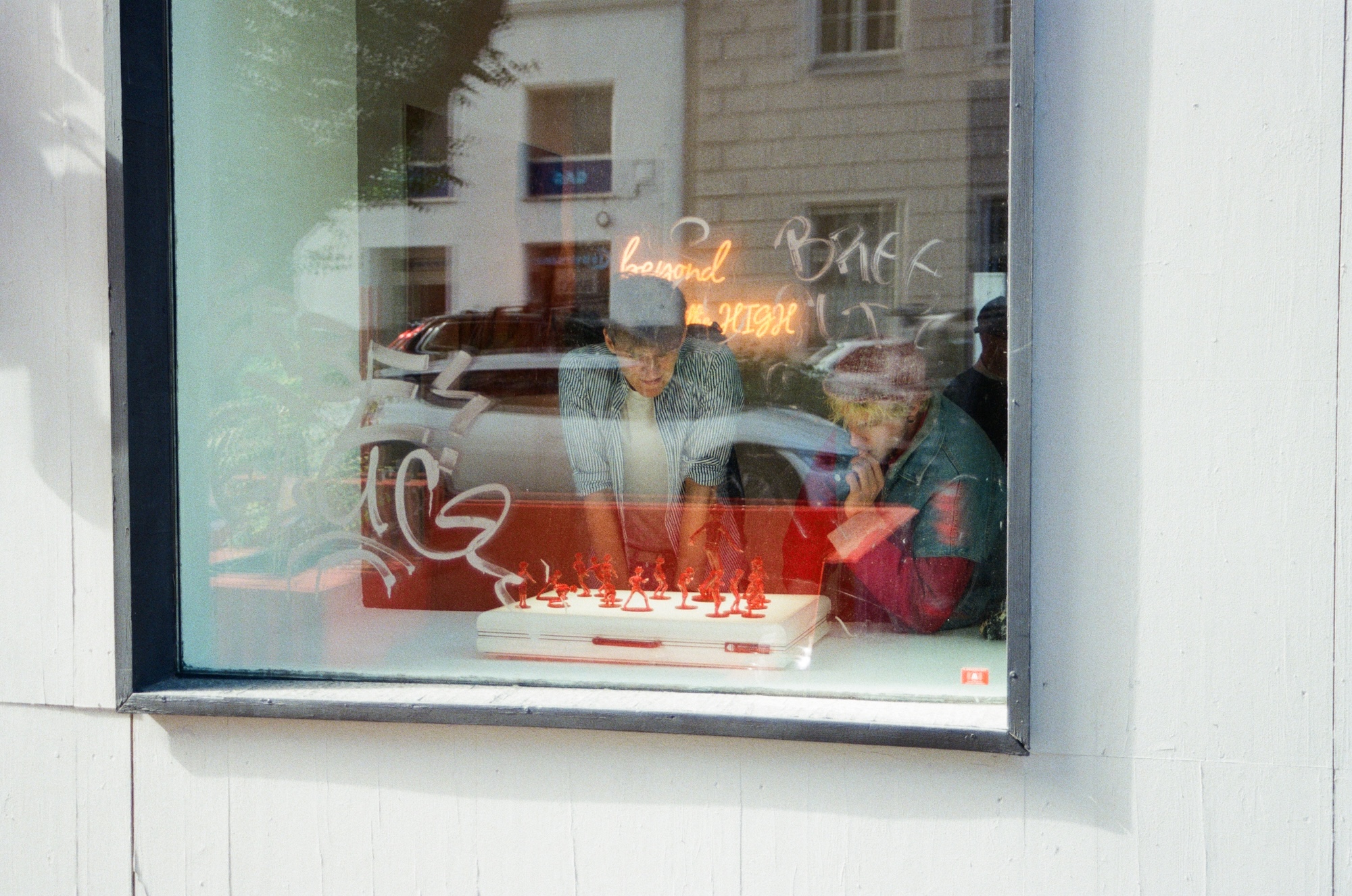
View of Beyond the High. The Chemsex Experience: Crisis, Resilience and Community through the window at Entre.
Nikola HergovichCezanne-ish still lives of apples, squashes and tomatoes, strangely distended or swollen, some with mirrored growths like conjoined twins, some sliced open to expose jarringly flat cross-sections.
MEDIENWERKSTATT
Next we visit Medienwerkstatt Wien, where installation of the group exhibition Uncanny Gardens is still underway. An artist descends a ladder to talk to us about a series of phones suspended from the ceiling by chains, each playing videos of different forms of ‘healing practices’. Strips of fake grass are being unrolled to cover the floor, and monitors play digital renders of extinct plant life. My highlight, however, is a series of pastel drawings of lumpy, misshapen fruits by Anna Spengemann. Cezanne-ish still lives of apples, squashes and tomatoes, strangely distended or swollen, some with mirrored growths like conjoined twins, some sliced open to expose jarringly flat cross-sections. Rendered in thick oil pastel and humbly framed, they have something of a high-school art class’ wonky, earnest attempts at observational drawing – they prompt reflection on the coaxing of life’s more unruly and erratic developments into imposed frameworks of normativity.
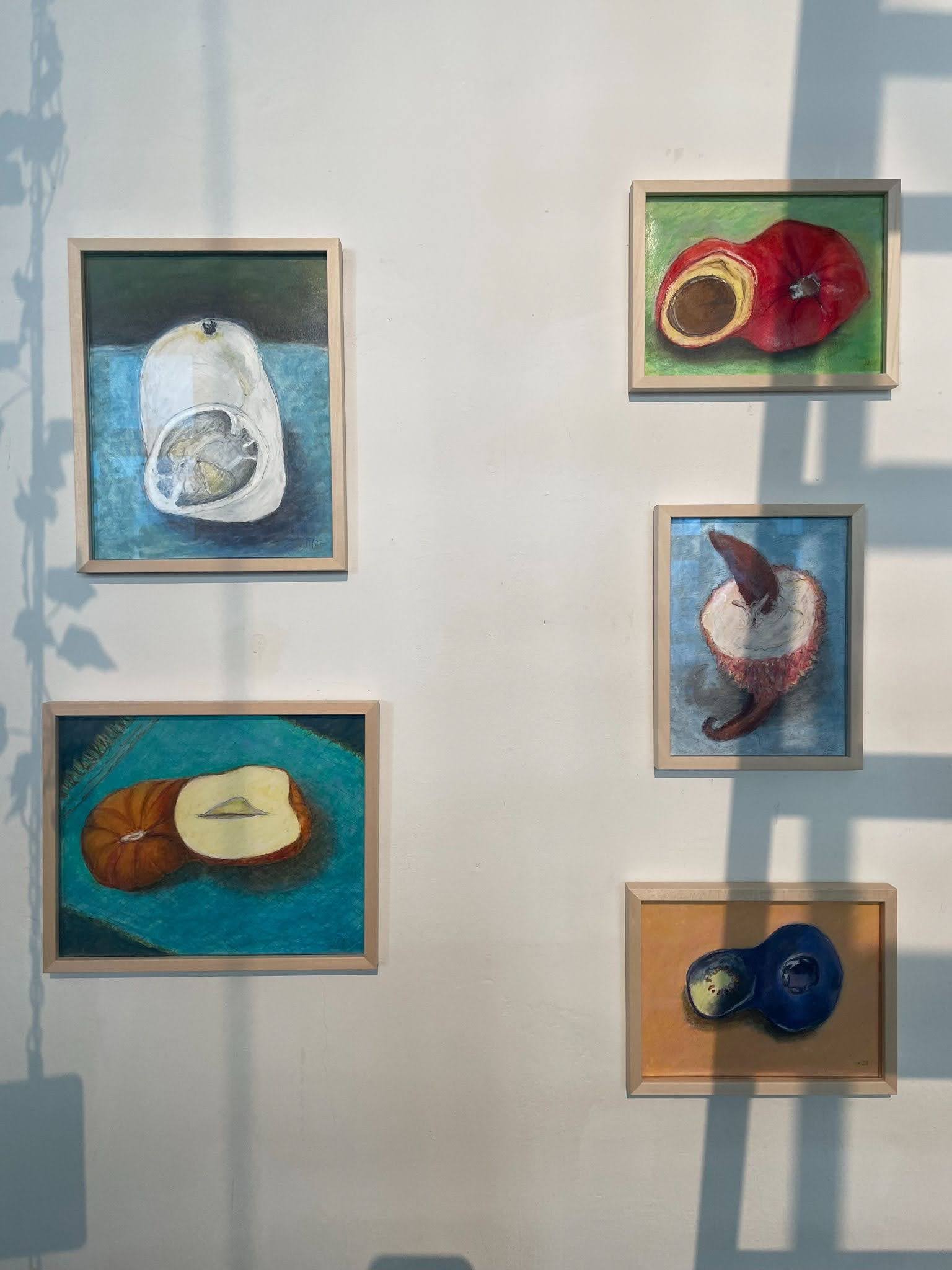
Drawings by Anna Spengermann at Medienwerkstatt.
Bryony DawsonCoiled bands of silicone, synthetic hair, red pins jammed into squashy ridges, held in place with steel bolts. Shades of translucent sickly pink like calpol, or matte rubber black sprouting white lashes.
LAURENZ + SHIMMER
Similarly uncanny and nascent-seeming forms are found at Laurenz in the work of Marlie Mul. Coiled bands of silicone, synthetic hair, red pins jammed into squashy ridges, held in place with steel bolts. Shades of translucent sickly pink like calpol, or matte rubber black sprouting white lashes. Something furled and intimate about them, but also technical and precise in contrast with the former horse-stable’s uneven brick floor and crumbling walls. Accompanying Mul’s series is the squealing, slapstick revelry of Mike Kelley’s first solo video work, The Banana Man, in which Kelley performs as a character from a children’s television show that he never saw for himself, but constructed based on anecdotes from friends. The exhibition was conceived as a collaboration between Laurenz and Rotterdam’s Shimmer, and in their courtyard introduction, the curators describe their shared interest in highlighting the conversations and conditions that surround artistic practices, as well as expanding an understanding of what independent art spaces can be. They tell us they haven’t written an exhibition text yet, but plan to produce a collectively written text during the run of the show – a nod to the exhibition as a durational, mutable set of relations that can and should accrue meaning beyond an opening night.
the exhibition as a durational, mutable set of relations that can and should accrue meaning beyond an opening night.
SALON FÜR KUNSTBUCH
There is palpable excitement among our little troupe of press people as we descend into what we think is an art bookshop. I overhear the phrase ‘porn for art writers’ and some chuckled humble brags about how many books one has at home and what a problem it is but how they keep buying more anyway. We soon learn however that this is not a shop but a ‘model of a bookstore at the scale of 1:1’, an archive presented as an installation, and that many of the books are not to be touched. We hear that there is a web store where the books are listed, but that there is no guarantee that SfKB’s Bernard Cella will be able to find the title – in this case he tells buyers that the book is unavailable. Confusion mounts, and the discussion veers towards tense as a couple of people find diplomatic ways of saying they don’t really get it. I’m grateful when T, one of the other writers invited by the festival, finally expresses what I think many of us were struggling to articulate: books and archives are usually associated with a desire to collect, exchange, and facilitate access to knowledge – but here, the intention seems to be to compile them as static display objects. Still, Cella’s response remains aloof and dismissive, and we’re soon on our way.
THURSDAY NIGHT
After light sustenance and a much needed sit-down at Cafe Savoy, it is Opening hour. More walking and space cruising, but now with an ice-bucket-wet can of beer at every stop. We see paintings of knock-kneed nudes with droopy roses at Grossraum, a slow choreography with flashing bike lights at hinterland, and at SUPER, I admire the beautiful wood-panelled ceiling covered in a surprising number of plug sockets. It is said that Ve.Sch is where everyone will end the night drinking until late, but after crouching through a long, densely crowded performance involving various drum sets played with very very long drumsticks, we get overheated and fidgety and decide to head on to new jörg. I think we like the simple pun and the way it makes people lean into the umlaut with a silly smirk. We’re heading to New Jooeuuurg - wanna join?
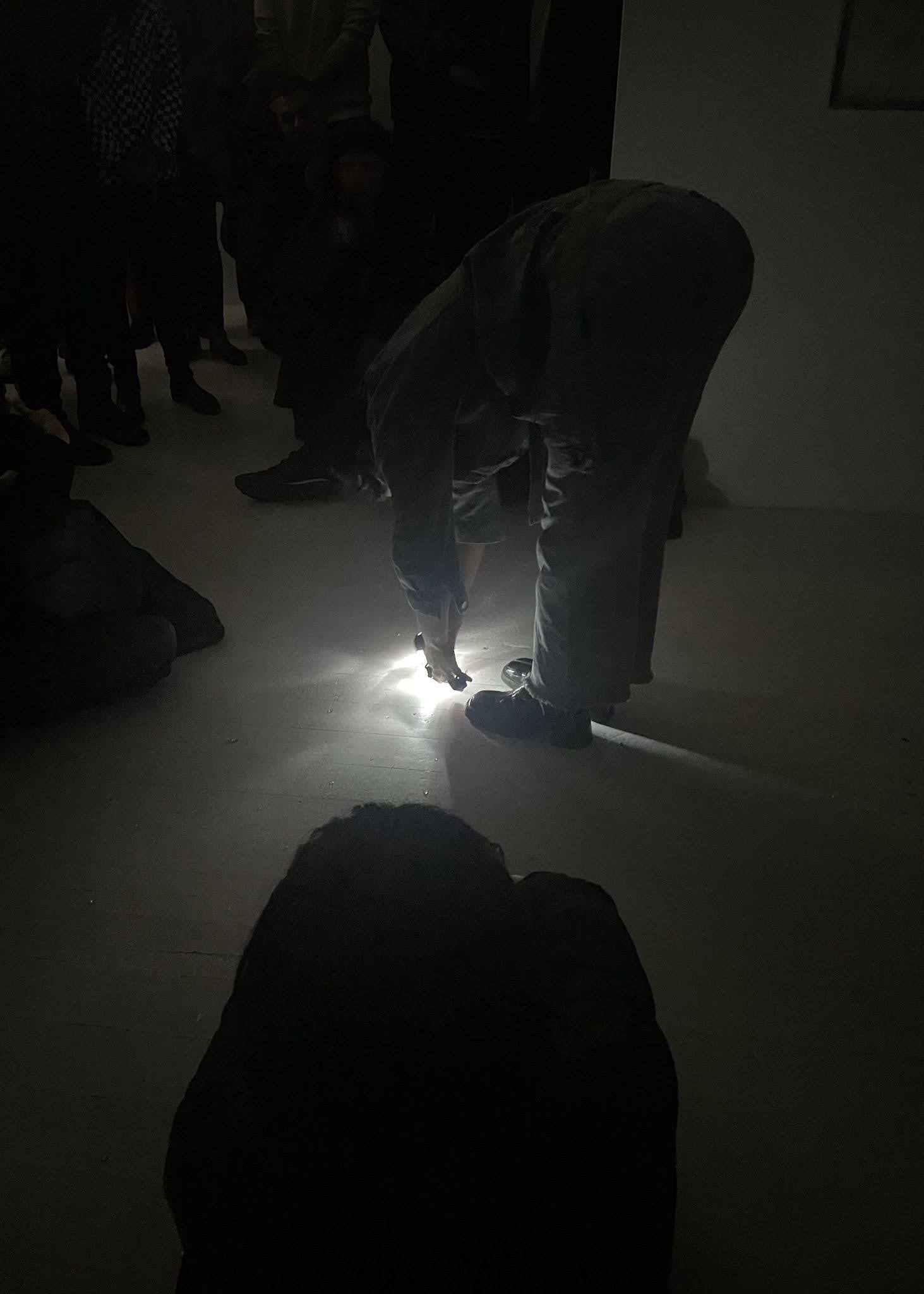
Bike-lights performance at Hinterland
Bryony DawsonCurved, meshed, shadowy surfaces in washed-out tones that trick the eye, swapping between convex and concave, interior and exterior, depending on what the mind thinks it is supposed to see.
NEW JÖRG
Dusty paintings of masks by David Gruber. Curved, meshed, shadowy surfaces in washed-out tones that trick the eye, swapping between convex and concave, interior and exterior, depending on what the mind thinks it is supposed to see. The atmosphere in the space is welcomingly calm, almost reverential. I drift about for a while, glad for a moment of silence and a nicely abstract exhibition text to wallow in. Outside on the street, conversation is loose and chatty; everyone seems to know each other. I indulge in the usual expat small-talk about respective home cities (Vienna, Berlin, Paris, Warsaw, Melbourne) and their characters, their scenes, their varying degrees of gentrification. We throw around quippy, sarcastic comparisons with the kind of hyperbolic conviction that happy drunkenness does best.
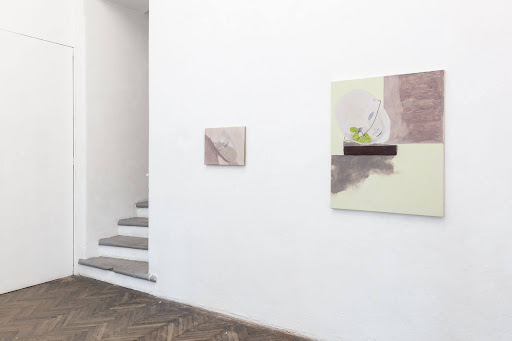
View of Persona by David Gruber at New Jörg
Flavio Palascianowhat do the terms ‘independent’ and ‘institutional’ really mean here? Which forms of dependency are acknowledged and which are shunned?
INDEPENDENT?
A question that arises again and again over the weekend is: what do the terms ‘independent’ and ‘institutional’ really mean here? Which forms of dependency are acknowledged and which are shunned? I hear offspaces described as “almost an institution now” because of their longevity and/or deepening scene-influence. Other offspaces are introduced as “not commercial though sometimes they do sell” – a statement not necessarily intended as criticism, though it usually implies discomfort about what it means to engage with the art market. The labels attached to these spaces clearly matter to people, even if they are constantly blurred, shifting, or formed in relation to what they oppose. Since its founding, the Independent Space Index has actively encouraged discussion around these themes. One of this year’s panel talks brought together spaces with ‘museum’ in their names to discuss how the term influences curatorial approaches; another panel talk raised issues of competition, jealousy and criticality in a scene where social and professional relationships are near impossible to untangle. In 2020, a panel discussion titled “Vienna’s independent scene as an international, decentralized institution” asked what it would mean to institutionalise such a diverse range of activities; what kinds of frameworks and unilateral values these spaces could benefit from, and what might be lost in the process.
The labels attached to these spaces clearly matter to people, even if they are constantly blurred, shifting, or formed in relation to what they oppose.
PECH
Nicolas Jasmin’s solo show at Pech, curated by one of Index’s organisers Bruno Mokross, gives form to this kind of open-ended questioning. In the exhibition text Bruno writes: ‘Here the challenge is to “address the elephant in the room”, as they say, without applying preemptive obedience through either censorship or contextualisation, both of which are institutional strategies which I cannot imagine not to be rather detrimental to the experience of art itself’. A large piece of plasterboard mounted vertically on legs takes up most of the small room. The first side you see as you come down the steps is painted rust red and blocks the view of something making a hissy birdsong sound. The other side is green with a border of smudged white patches of sanded-down plaster filling former screw holes. The birdsong comes from a small TV, which displays a few looped seconds of the actor Klaus Kinski smiling at the camera with a butterfly on one finger. When Jasmin first made the video in 2000, it was difficult to show because institutions were worried about copyright issues – the clip is taken from Herzog’s film Mein liebster Feind. Later, in 2013, it was difficult to show because it became known that Klaus Kinski had been continuously abusing his daughter Pola. The exhibition seeks a way of asking (not telling) what it might mean (or not mean) to appropriate and recontextualise a difficult image. In my mind, the plasterboard painting speaks to the exposure and ongoing manipulation of an interior structure: usually these sanded plaster dots are visible when a building is in an in-between state – being built, demolished, or repaired. It suggests a state of vulnerability, nudity, something undone or in progress, not yet sealed up. It’s an opportunity to think things through.
a state of vulnerability, nudity, something undone or in progress, not yet sealed up. It’s an opportunity to think things through.
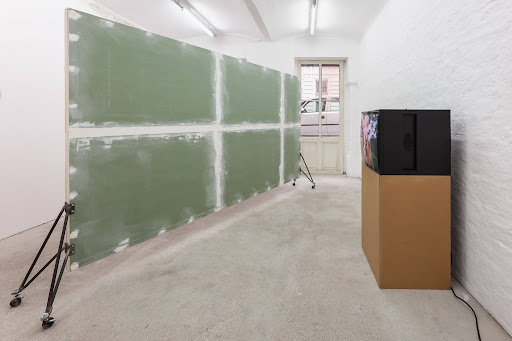
View of L’Insecte by Nicolas Jasmin at Pech.
Flavio PalascianoWe gradually stopped talking about art and instead exchanged notes on throuples, insecure aristocrats, whether or not Ben Lerner is any good, whether or not Virginia Woolf is ‘one of the big boys’.
FRIDAY NIGHT
T, A and I aimed to continue on to an opening on Friday night, but paused for beers along the way and did not recover momentum. On the terrace of Prückel, one of Vienna’s good old fashioned cafes, we ate Spargelsuppe, Spinatknödel, sausages and cream cake, and googled the wonky, aggressively spray-painted Karl Lueger Monument in the square opposite us. We gradually stopped talking about art and instead exchanged notes on throuples, insecure aristocrats, whether or not Ben Lerner is any good, whether or not Virginia Woolf is ‘one of the big boys’. Inside the gold-trimmed cafe an old man played a grand piano and possibly winked at us. In the stairwell to the bathrooms, I paused to admire a cabinet full of variously sized snowglobes, each containing a plastic Mozart head.
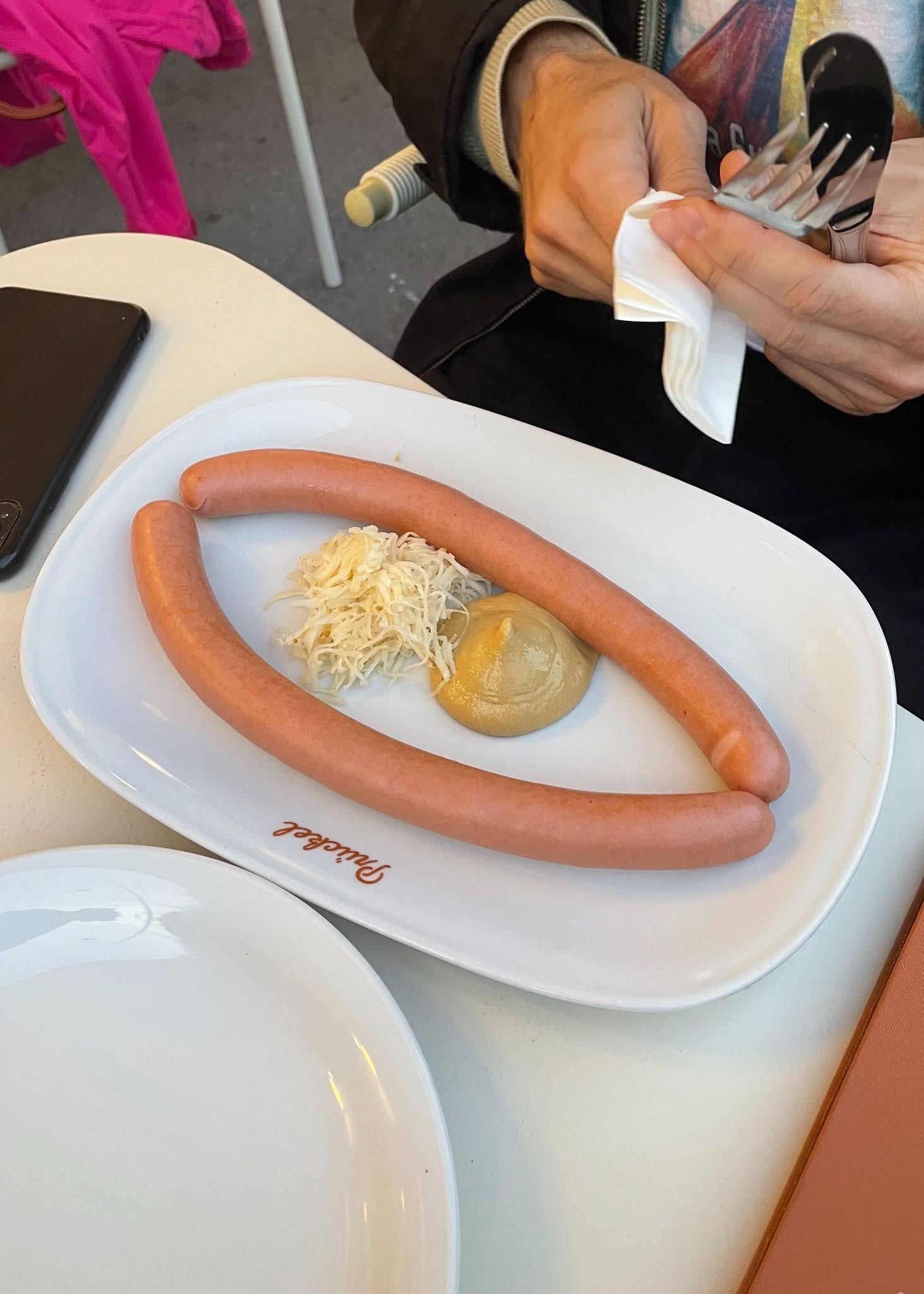
Viennese Cuisine at Prückel.
SATURDAY AFTERNOON
Was hot and slow. A and I found a sleepy meditative rhythm as we cycled our Next bikes around the city, ticking off as many of the remaining spaces as the lazy heat would allow before A’s evening flight back to Paris. Sweaty, quiet, spending no more than 10 minutes at each, stuffing press text after press text into our bags along with the dog-eared red Index guide, photographing everything on our phones so we could remember it later. Ice cream for lunch, a Billa Brötchen for second lunch. A quick dip in the fridge-like cool of the Opera House Tiefgarage to see VAN: an exhibition space in the boot of a car.
I found a sleepy meditative rhythm as we cycled our Next bikes around the city, ticking off as many of the remaining spaces as the lazy heat would allow before A’s evening flight back to Paris.
PILOT
As anyone will tell you, Pilot is a beautiful space with dark wooden panelling and idiosyncratic gothic details. The project is run by three flatmates/artists in the connecting room of their apartment. Light glowed through a stained glass window in the hallway as we helped ourselves to the Sprudelwasser set out for visitors. For this exhibition, Melbourne-based artists Jasper Jordan-Lang and Alexandra Ragg responded to an old Austrian myth about a farmer who tricks the devil into building a mill for him. Jasper tells me that his narrow wall sculptures reference the shapes of windmill sails, but their burnt orange and warm yellow tones were an arbitrary choice; a liberty he took due to gaps in information about the original mill. To me they have a remote pop-art quality – clean and precise, with perforated metal details threaded neatly into grooves in the painted surface to make a sliver of polka-dot. I think of them as shards of a 60s TV studio backdrop. Alexandra Ragg’s paintings, meanwhile, are earthy impressionistic blurs suggesting a swampy forest clearing or dappled light through pressed eyelids.
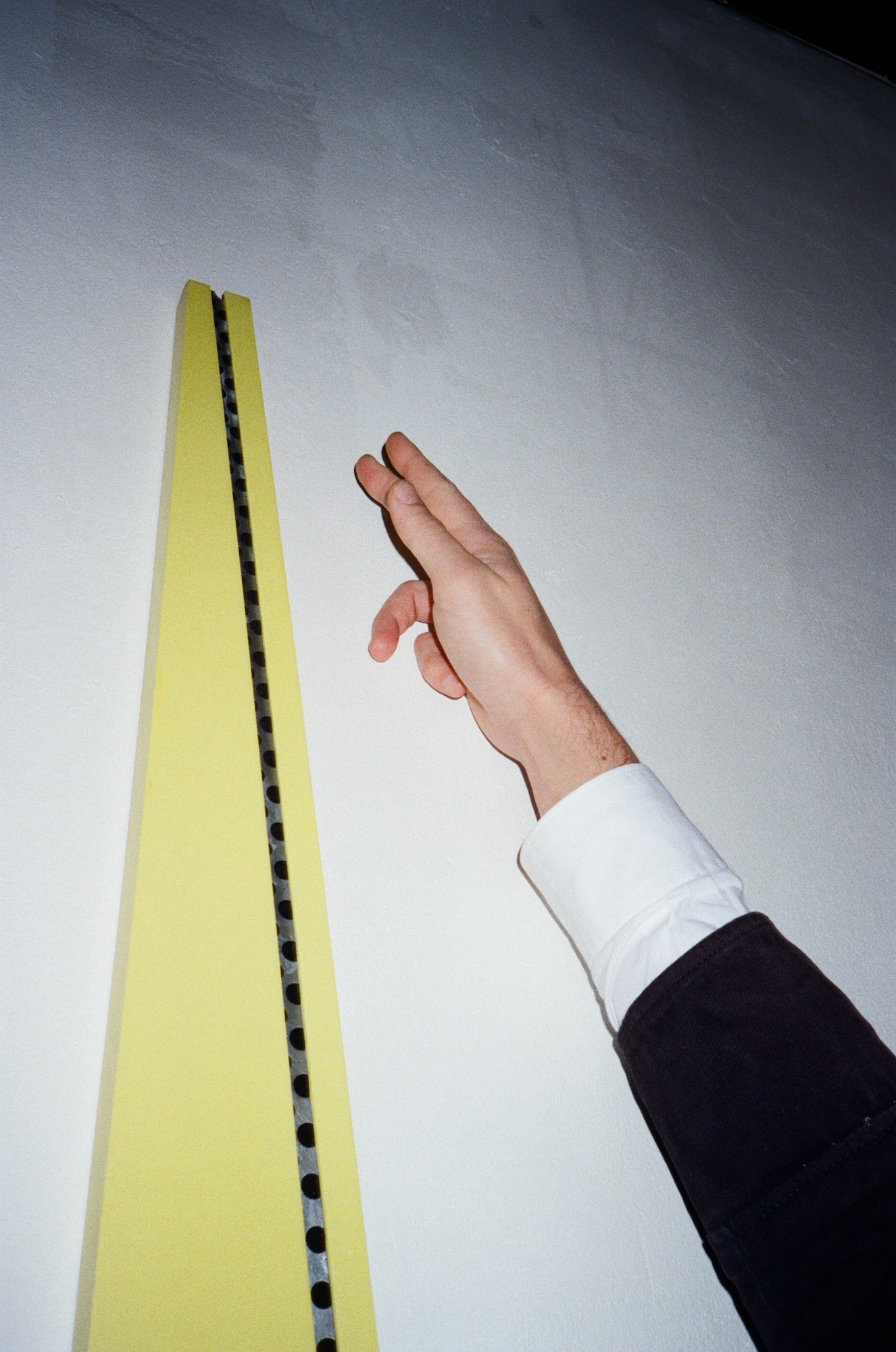
Detail of work by Jasper Jordan-Lang at Pilot.
Lukas Meixnerdimensions, perspective and virtuality; time as convexed and punctuated by lines meeting. “You and the other next to you are two moments. As long as you are looking at the same thing. When you look at each other, does it?”
CAN
At Can – a project in a small boxy room next to the elevator shaft of the ridiculously named ‘TownTown’, (an urban development project) we see Calendar, a series of paintings by Nina Zeliković on curved pieces of plywood whose side profiles, when seen from the room’s doorway, formed an almost-continuous oval – a bit like a skatepark fullpipe. The paintings themselves are fragmented, smudgy, loosely geometric. The press release, written by performance artist Adrienne Herr, is similarly fractured and elliptical. It speaks of dimensions, perspective and virtuality; time as convexed and punctuated by lines meeting. “You and the other next to you are two moments. As long as you are looking at the same thing. When you look at each other, does it?”
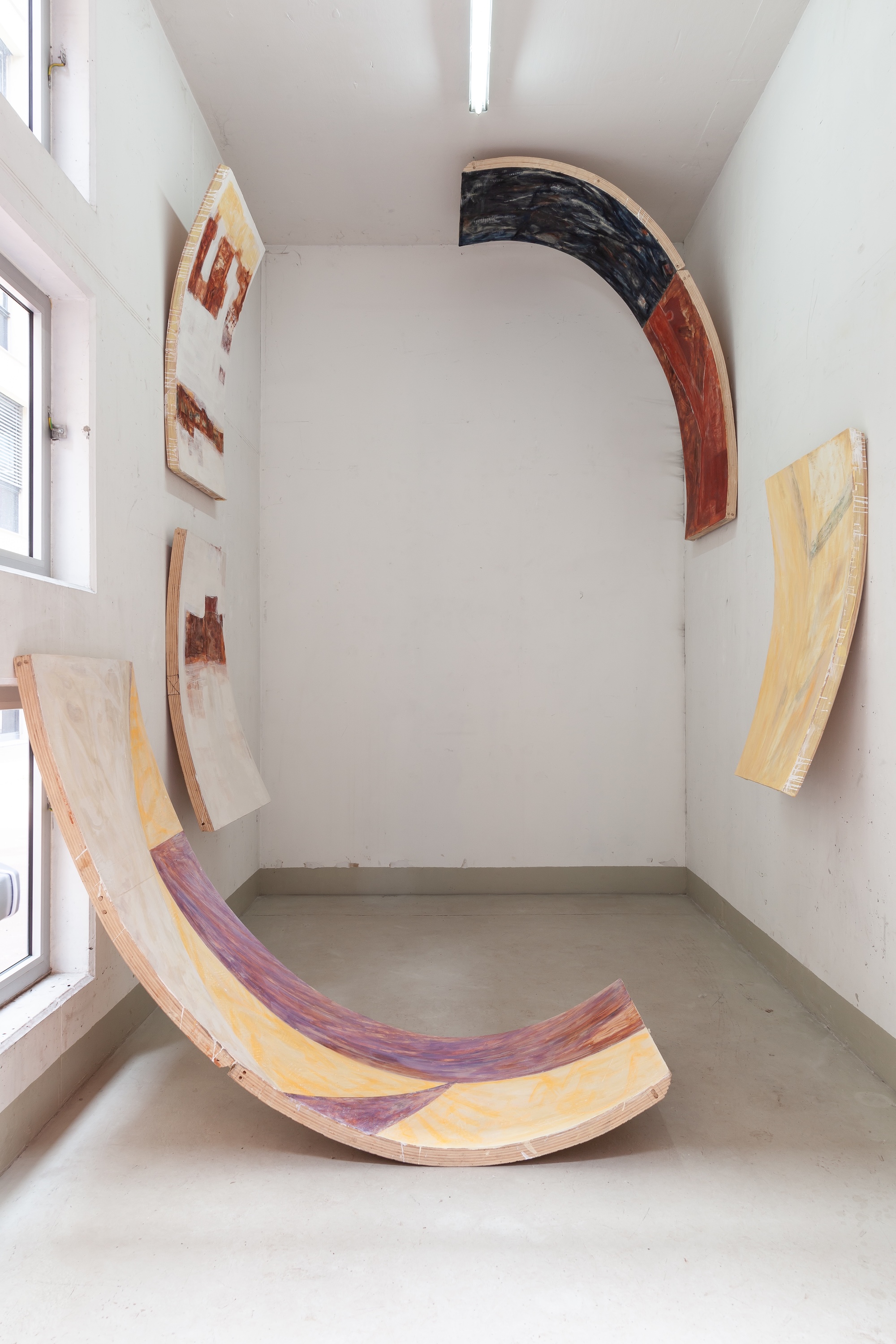
View of Calendar by Nina Zelković.
The person guarding the exhibition tells us he’s not the one running the space, just a friend helping out. He shelters from the sun on a bench by the space’s entrance, a book by Michel Houellebecq beside him – the french author infamous for delighting in sexist, racist, nihilistic provocations. The three of us share a giggle about this. Because it is quite bold to read Houellebecq in public, no? A warm, easy conversation follows about the strange pleasure of reading such flagrantly misanthropic work — about never being quite sure how seriously the author inhabits the views that we enjoy (guiltily?) as satire. And, at the same time, as mainstream politics is increasingly flooded with the populist rhetoric of the far right, how necessary it might be to engage with such positions as more than entertainment.
That fleeting bit of intimacy and mutual recognition that a chat in an out-of-town offspace affords. The conversations that arise between strangers brought into the same room by a broad but particular field of interest; the gestures of improvised hospitality that accompany irregular opening hours and unconventional architectures.
“Ahhhh, that’s what it’s all about!” I say to A as we walk back to our Next bikes. That fleeting bit of intimacy and mutual recognition that a chat in an out-of-town offspace affords. The conversations that arise between strangers brought into the same room by a broad but particular field of interest; the gestures of improvised hospitality that accompany irregular opening hours and unconventional architectures. For me, those contingent encounters are what distinguishes an independent scene. If this seems to underplay the value of artworks themselves, I don’t mean it to. To paraphrase a friend of mine: art is at its best when it acts as a placeholder for other kinds of exchange. It’s as much about the work as it is about the conversations that happen in its orbit.
GARTENHAUS
After saying my goodbyes to A, I cycle to KUNSTVEREIN GARTENHAUS for a performance by Vittoria Totale. The room and hall are packed full despite the heat. People sit on the floor squeezing their knees to their chests, or lean against the walls, fanning themselves with the press release. I was too late to get into the main room and unable to see over the heads in the doorway, so I listened blindly from the hall. As with all readings or text-heavy performances, it isn’t easy to recount the content of Vittoria Totale’s work, but I do remember looping, layered repetitions, a moody tone that may have been sarcasm or poetic sincerity or a self-aware sliding between both. I also remember the final piece: a rhythmic, genuinely touching text about aging, in which Totale counted down from the age of 29 to 1, alluding to shifting attitudes towards youth and maturity via responses to the question ‘how old are you?’:
When I was 18 I used to say I was 18, when I was 17 I used to say I was young, when I was 16 I used to say I was 16 or 18 (…) when I was 9 I used to say it was the same number as my birthday’s day, when I was 8 I used to say I was oche (…) When I was 5 I used to say I would soon be 6 (…) when I was 3 I used to say I was 3, when I was 2 I didn’t think about time, when I was 1 I also didn’t think about time.
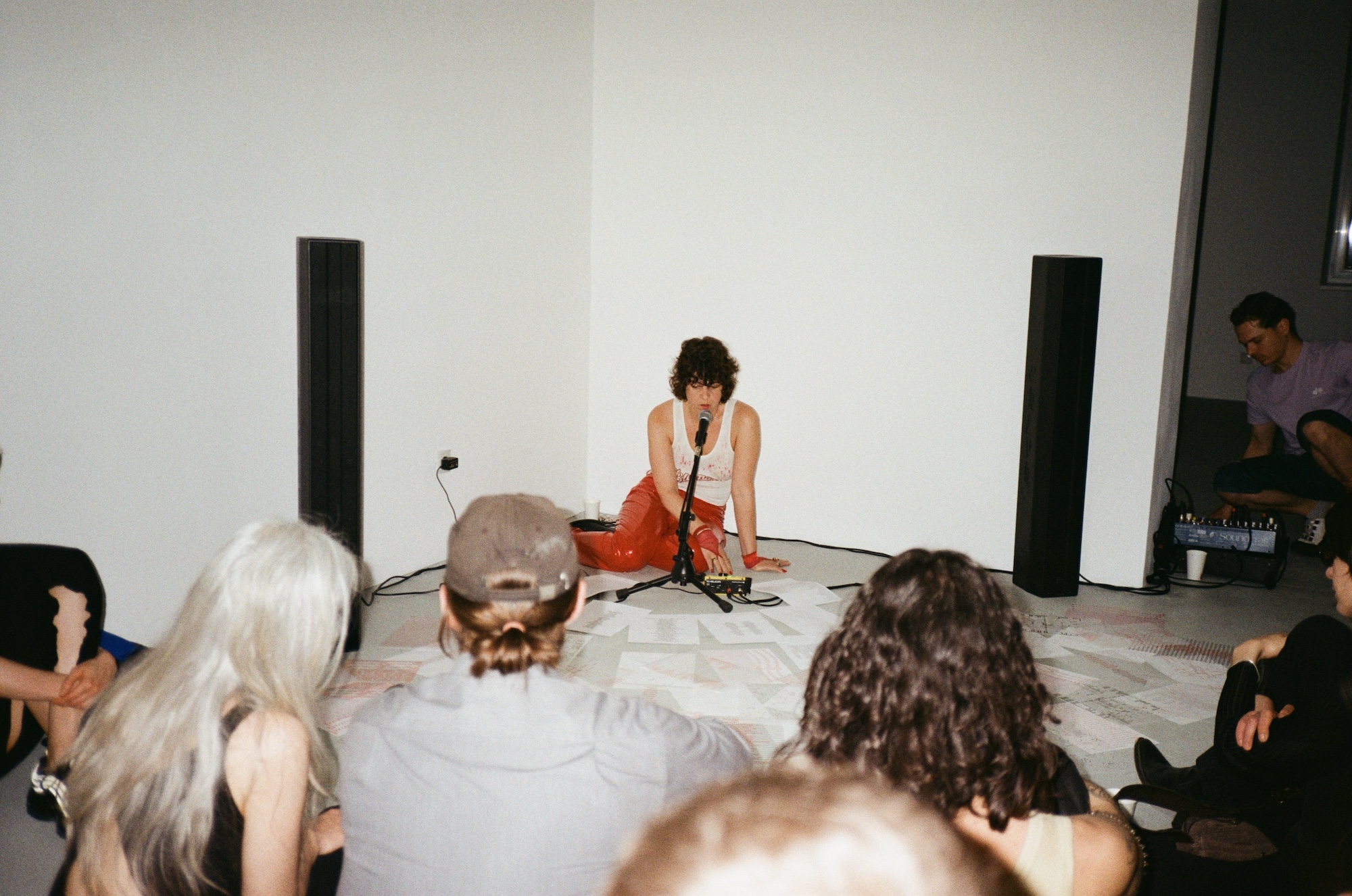
Vittoria Totale performing at Kunstverein Gartenhaus.
Nikola Hergovich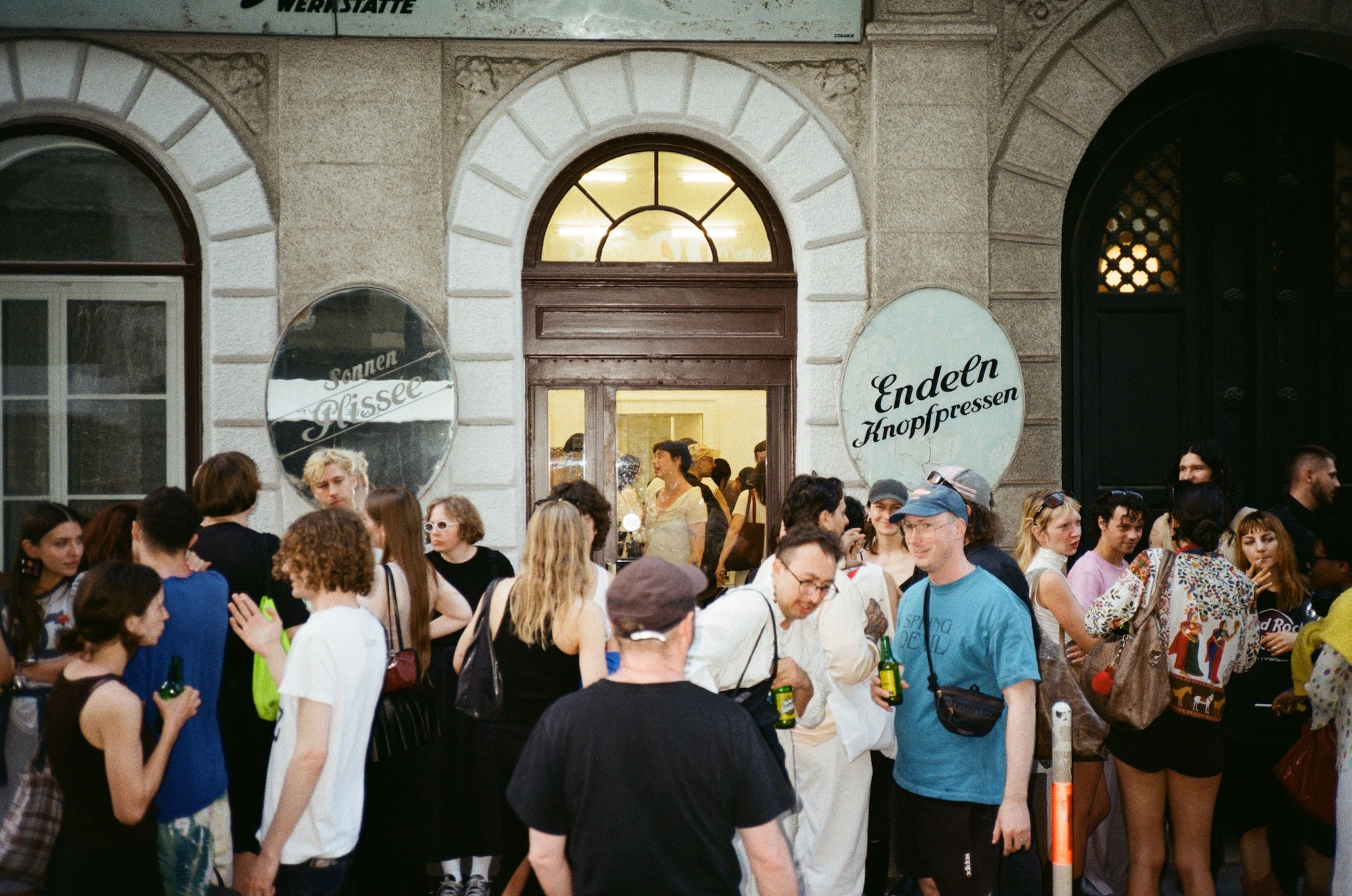
Outside at Kunstverein Gartenhaus.
Nikola HergovichAfterwards, everyone empties out onto the narrow street to drink, talk, smoke. Buses come by every few minutes or so, and we press against the building to let them pass, only to spill back into the road again. At openings, my favourite people to meet are the ones who turn out to have little to do with art, and do something completely different like working for the UN. I don’t remember his name but while chatting outside Gartenhaus he moved gracefully between friendly small talk about what it’s like to work for the UN and the live football being streamed on his phone – the Paris-Milan game was reaching a climax. He tells me he isn’t an artist but likes to come to these things to hang out because he meets nice people. I ask if he doesn’t find the artworld and some of its claims utterly bizarre and painfully posturing in comparison to his line of work. He says he doesn’t really think about it like that – and something about the simplicity of his response is profoundly reassuring.